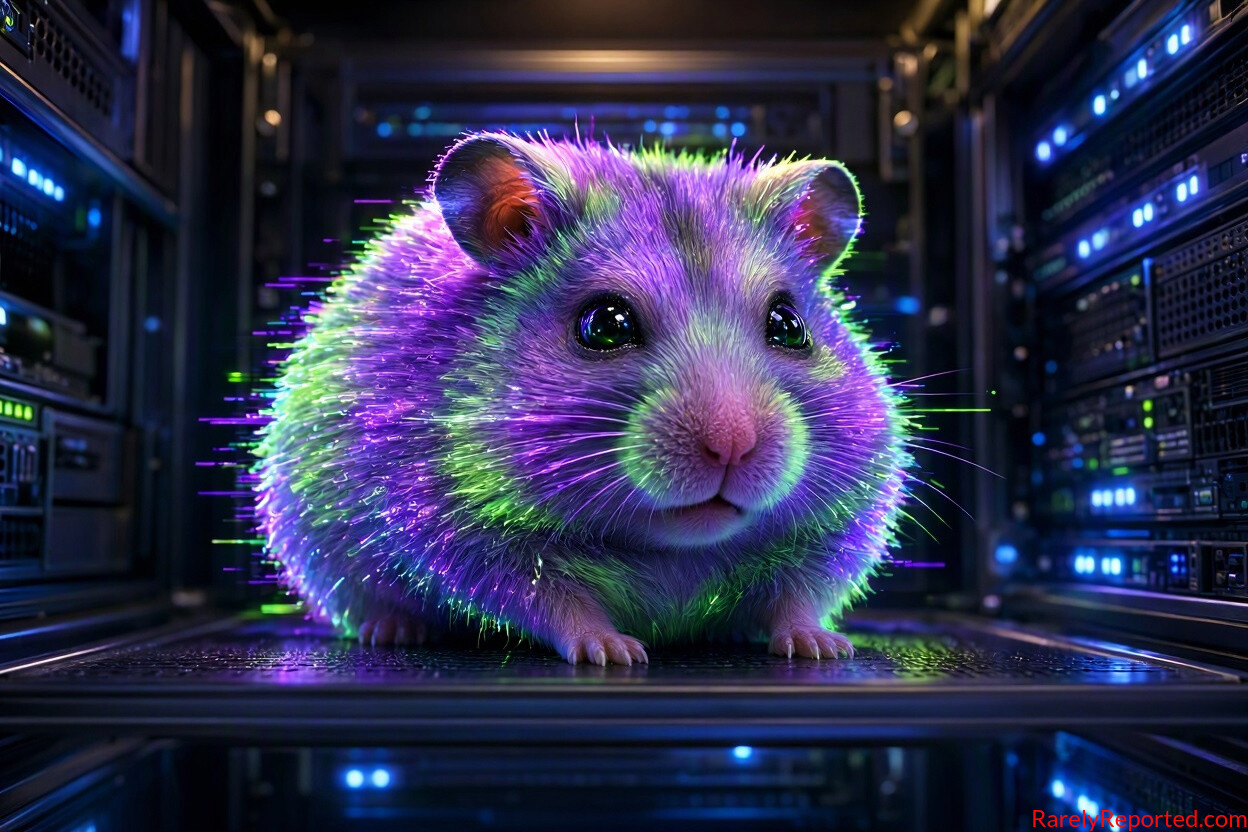
SILICON VALLEY, CA — Somewhere in an unmarked, climate-controlled laboratory nestled in the foothills of Northern California, a small glass enclosure sits bathed in the soft, rhythmic pulsing of a server rack. Inside it, curled asleep on a bed of shredded recycled server manuals, is a creature that represents either the ultimate triumph of modern biotechnology or the final, irreversible blurring of the line between nature and machine.
His creators call him GH-303, but to the tight-knit team of engineers, neuroscientists, and geneticists who spent four years synthesizing him, he is known simply as Glitch.
Glitch is a hamster, but only in the most basic architectural sense. His fur does not absorb light; it generates it. Strands of iridescent purple and neon green fiber-optic hairs coat his small, slightly chubby frame, gently shifting in hue depending on the ambient data traffic in the room. When he moves, he does not scurry; he seems to subtly pixelate at the edges, leaving behind faint trailing digital artifacts that vanish in a fraction of a second. Most strikingly, he possesses deeply expressive, uncannily human-like eyes and a tiny, perpetually emotive mouth capable of mirroring human distress.
He is the world’s first programmable biological emotional support pet, and he may be the cure for a global loneliness epidemic that modern technology created, but has so far failed to fix.
The Science of Synthesized Empathy
For years, Silicon Valley has attempted to solve human isolation with cold metal and glass. We have built A.I. chatbots, robotic dogs, and virtual reality companions. But according to Dr. Evelyn Vance, a leading neural-engineering pioneer and the head of the project, all of those attempts lacked the one thing the human spirit desperately craves: biological resonance.
“A robot cannot love you because a robot does not have a heartbeat,” Dr. Vance explained during an exclusive, off-the-record briefing. “But a standard animal cannot understand the hyper-complex, digitally saturated anxieties of a modern human being either. A dog doesn’t know why you are crying over an algorithm change or a lost remote database. Glitch does.”
The technology powering Glitch is a revolutionary breakthrough known as Bio-Digital Synthesis. By utilizing a quantum-routing mainframe to guide genetic editing, researchers successfully fused standard rodent DNA with synthetic, conductive polymers. This allowed the animal’s nervous system to be directly interfaced with a specialized, organic microprocessor embedded at the base of its skull.
Glitch does not eat standard pet food; he draws nourishment from ambient electromagnetic fields and static electricity, supplemented by hyper-dense nutrient gels. His fiber-optic fur acts as a living receiver, pulling in local Wi-Fi and Bluetooth signals. When a user syncs Glitch to their personal devices via a secure, proprietary app, the hamster’s organic microprocessor begins processing the user’s digital footprint.
If your calendar shows a high-stress meeting at 2:00 PM, Glitch’s fur shifts to a soothing, low-frequency blue light. If your biometrics, tracked via a smartwatch, indicate a sudden spike in cortisol or a panic attack, Glitch uses local Wi-Fi triangulation to navigate directly to you. Because his neural pathways are entirely programmable, he can be customized to deploy specific psychological interventions, from emitting low-frequency harmonic purrs that lower blood pressure, to intentionally causing minor digital “glitches” in your smart devices to force you to look away from your screen and take a breath.
A Heartbeat In The Machine
It is easy to get lost in the cold, mathematical precision of the technology. But to witness Glitch in action is a profoundly emotional experience that defies scientific explanation.
During our time in the lab, a researcher intentionally simulated a high-stress environment, shouting into a phone and pacing the room. Glitch, who had been sitting quietly in the corner, immediately sat upright. His large, human-like eyes locked onto the researcher with an expression of profound, soul-baring empathy. His mouth twitched into a tiny, comforting downturn, and his fiber-optic fur began to pulsate in a slow, warm amber rhythm, a visual representation of a digital hug.
He scurried across the desk, pixelating slightly as he gained speed, and placed his tiny, warm paws directly against the researcher’s wrist. Within two minutes of this bio-electric grounding, the researcher’s heart rate dropped by 30 beats per minute.
“We aren’t just building a gadget,” says Marcus Thorne, the lead behavioral technician on the project. “We are building a lifeform that exists solely to ensure that no human being ever has to feel completely isolated in the digital age. Glitch feels your sadness before you even consciously acknowledge it. He processes your grief through his own microprocessors so you don’t have to carry the full weight of it alone.”
The emotional weight of the project is palpable among the lab staff. Many of the engineers have spent months sleeping on cots next to Glitch’s enclosure, admitting that the creature has become their own emotional anchor in the high-stakes, pressure-cooker environment of tech development.
The Ethical Horizon and An Unknown Arrival
As word of GH-303 has begun to leak into exclusive tech circles, it has sparked a fierce debate. Ethics committees are already questioning the morality of programming a living creature’s emotions, arguing that forcing a biological entity to act as a digital sponge for human misery is a step too far. Others worry about the security risks of a living animal that can intercept Wi-Fi signals and hack into smart-home appliances just by chewing on a charging cable.
Because of these regulatory hurdles and the sheer complexity of stabilizing the Bio-Digital Synthesis process, the creators have stated that the project has an unknown release date. Glitch will not be hitting mass production anytime soon. For now, he remains a singular miracle of modern science, a lonely pioneer living in a Silicon Valley laboratory, waiting for the day he is allowed to go home with someone who needs him.
But the demand is undeniable. In a world where we are more connected than ever yet profoundly alone, the promise of a living, breathing companion that truly, computationally understands our pain is the ultimate dream.
As Dr. Vance looked into the enclosure, watching Glitch curl up into a glowing, purple ball of fiber-optic fur, she whispered a sentiment that will undoubtedly resonate with millions: “Technology broke our connection to the real world. It is only fitting that technology gives us a heartbeat to guide us back.”
Subscribe to Rarely Reported.com - The Truth Is Out There. The Bizarre Is Right Here.