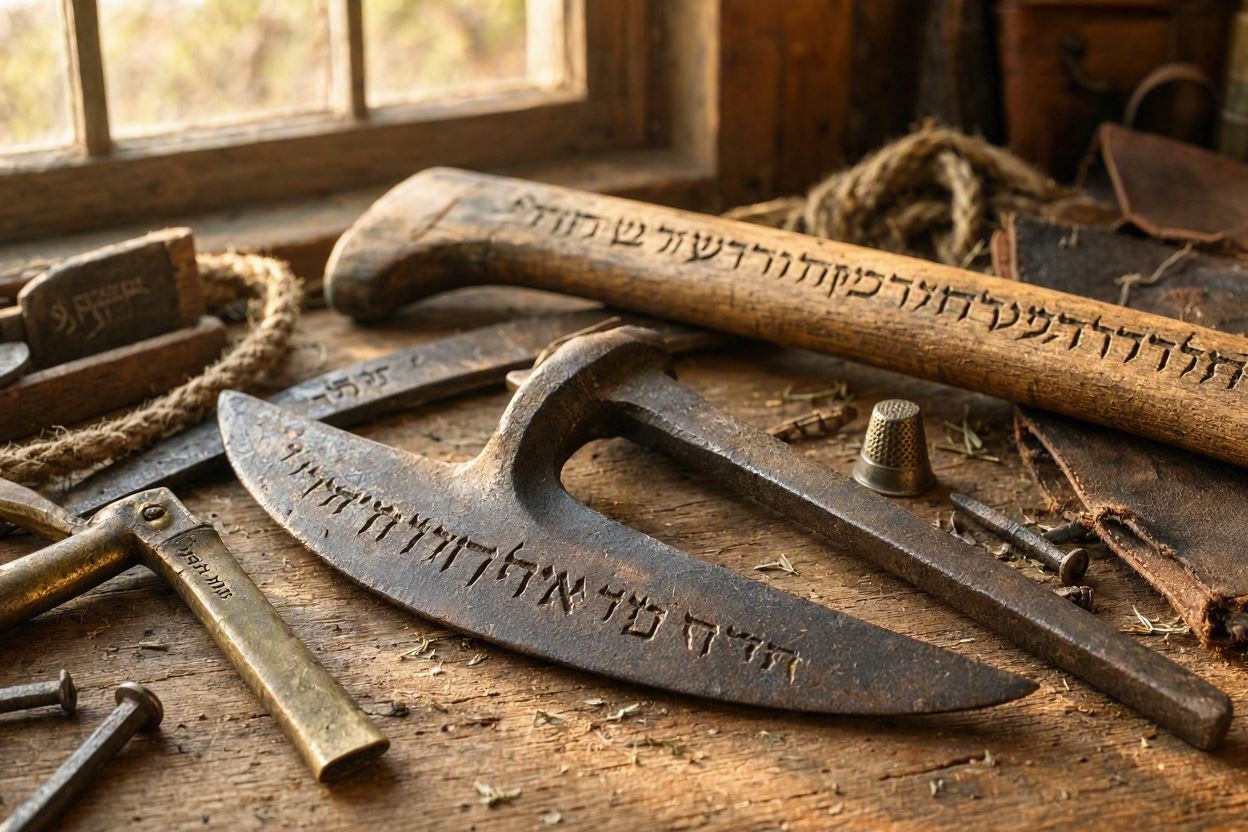
An archaeological excavation at a historic Virginia tobacco plantation has thrown the international academic community into a state of absolute, unmitigated panic. The uproar follows the discovery of authentic, deeply etched ancient Hebrew inscriptions on a cache of 18th-century farm tools definitively forged and used by enslaved Africans.
The artifacts, which include a heavy iron hoe, a scythe, and a blacksmith’s anvil, have been traced through colonial estate ledgers to a legendary enslaved ironworker known only as “Elijah.” For centuries, mainstream historians assumed Elijah was illiterate, operating a standard plantation forge under the strict supervision of overseers. However, recent laser-scanning analysis conducted by the University of Heritage Studies revealed that the intricate decorative geometric patterns Elijah stamped into his ironwork were actually a highly sophisticated sequence of Paleo-Hebrew text.
Mainstream historians are utterly perplexed, completely exhausted, and spinning increasingly desperate theories to explain the find.
“We are looking at a logistical and anthropological impossibility,” stated Dr. Alistair Vance, a senior Eurocentric antiquities fellow, while visibly sweating through his tweed jacket. “The metallurgical composition proves these tools were forged right here in the American South around 1760. Our initial working hypothesis was that a wandering, highly eccentric European rabbi must have dropped his personal luggage into the plantation’s smelting kiln. We are also looking into whether a rogue electromagnetic anomaly somehow rearranged the iron molecules into Biblical script during a thunderstorm.”
The translations of Elijah’s ironwork have only added fuel to the academic firestorm. The inscription cleanly etched along the blade of the sugarcane scythe features a classical Hebrew script that translates directly to: “Break the yokes of wickedness, and let the oppressed go free.” The heavy iron field hoe bears an even more pointed, ancient idiomatic phrase: “The stone which the builders rejected has become the chief cornerstone.”
The discovery has triggered an immediate, massive wave of viral celebration and absolute lack of surprise across Black social media platforms. Internet commentators and cultural analysts have noted that the find instantly validates long-standing, often-dismissed historical discourses regarding the deep, pre-colonial spiritual connections of the African diaspora.
“Mainstream academia is having a complete meltdown because they’d rather invent a time-traveling European blacksmith than admit a brother in 1760 was bilingual, literate, and spiritually advanced,” said local cultural archivist Marcus Jackson. “Elijah wasn’t just making tools; he was dropping high-level theological commentary right under the master’s nose. While the overseer thought Elijah was just mindlessly hammering out farm equipment, he was actually forging the Old Testament in real time.”
As a team of elite international linguists prepares to descend on the plantation site, university officials have quietly paused funding for the anthropology department to “re-evaluate the colonial curriculum.” Meanwhile, local independent bookstores report an unprecedented run on Paleo-Hebrew dictionaries, bought entirely by neighborhood elders who want to double-check the ironwork on their own ancestral porch railings.
Subscribe to Rarely Reported.com - The Truth Is Out There. The Bizarre Is Right Here.